| Asian ginseng
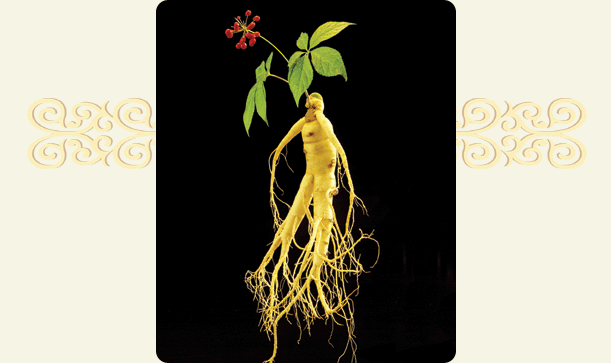
comes from the plant Panax Ginseng whose
botanical name is derived from the Greek
word panacea, meaning "cures everything"
and the word ginseng meaning "man-like"due
to its appearance of some roots. Ginseng
has been known as herbal medicines,
called as "longevity grass",
used in the Asian countries as a tonic,
fatigue relief, preventing aging, improvement
of circulation, protecting liver, etc.
for thousands years.
When it comes to ginseng farming,
Korea is generally evaluated to be
suited best for cultivation of ginseng
in term of climate, soil and other
natural environment.
Ginseng is not all the same. The
Korean ginseng species is Panax Ginseng
C.A. Meyer. C.A. Meyer, a 18th century
botanist, called it Panax Ginseng.
And Panax Ginseng is originated from
Korea and China. Panax Ginseng C.A.
Meyer has been known as the only species
with which lots of pharmacological
trials have been carried out.
The main ingredient of ginseng which
has pharmacological effects are the
unique Saponin. The Saponin of ginseng
is called "Ginsenoside".
It is known that there are over 30
kinds.
It is also known that the red ginseng
has several new saponins which are
not included in the white ginseng.
These new saponins are known to have
strong pharmacological effects. ("White"
ginseng is a naturally dried one.
"Red" ginseng is the one
which is steam-heated for hours. It
looks dark reddish brown.)
There have been some Chinese old
expressions showing pharmacological
effects of ginseng. (Korea Ginseng
Academy) They are as below :
1) Recover strength, saves health
: Recovers the weak health.
2) Helps blood, restore pulse : Vitalizes
blood formation and makes it circulate
smoothly
3) Good heart, calm health : Calms
the mind.
4) Life continues, relieves thirst
: allots the body fluid and relieves
thirst.
5) Supplements lung, good for respiratory
: Strengthens the lung and is good
for respiration.
6) Strengthens digestion : Strengthens
the digestive organs.
|











 What is BulRoGeon Red Ginseng